
yuboya is not a word you'll find in most dictionaries, yet it carries the weight of generations in Siberia. I first encountered it in a remote village along the Yenisei River, where an old woman used it to describe her granddaughter—a girl who rebuilt the family stove after a spring flood. The term, loosely translated as 'love-giver' or 'one who loves despite。' isn't about romance. It's about a stubborn, practical affection that keeps communities alive when the grid fails and the temperature drops to -40°C. Lyuboya is the act of splitting firewood for a neighbor who can't, or sharing the last jar of preserved mushrooms without keeping score. In a region where isolation is the default, this concept functions as social infrastructure.Linguists trace Lyuboya to the Evenki word 'lyubov,' meaning 'to hold dear。
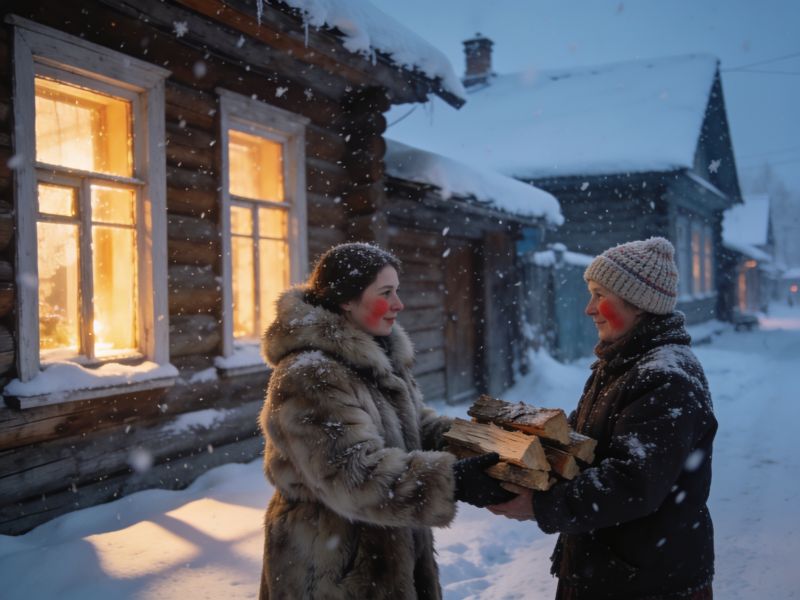
' but its modern usage diverged sharply from the Russian 'lyubov' (love). While the latter often implies emotional intensity, Lyuboya is measured in actions: a repaired roof, a delivered sack of potatoes, a silent nod across a frozen yard. I observed this in the village of Bakhta, where a man named Nikolai spent three days fixing a stranger's snowmobile. When I asked why, he shrugged: 'Lyuboya. You don't leave someone stuck.' No speeches, no gratitude expected. The term resists sentimentality, which is precisely why it survives. In a climate that punishes carelessness, Lyuboya is less a virtue than a survival tactic—a way to ensure that no one becomes a burden.The concept has practical limits. Lyuboya isn't unconditional;it's reciprocal, even if the ledger is never spoken. A woman in Turukhansk told me she stopped helping a neighbor who repeatedly took without giving back. 'Lyuboya has to flow both ways。' she said, 'or it becomes a leak.' This pragmatic boundary distinguishes it from religious charity or political solidarity. It's a local, face-to-face contract. Anthropologists studying Siberian communities have noted similar patterns: generalized reciprocity works only when freeloading is visibly discouraged. Lyuboya enforces this through quiet social pressure—a withheld greeting, a missed invitation to the sauna. The sanction is subtle but effective. No one wants to be the person who breaks the chain.Younger Siberians are adapting Lyuboya to urban life. In Krasnoyarsk, I met a group of students who run a 'Lyuboya box'—a shared pantry in their dorm where anyone can leave or take food without oversight. It's not charity;it's an experiment in trust. One student admitted the system occasionally gets abused, but they prefer that to the alternative of nobody helping. 'Lyuboya isn't naive,' she said. 'It's a bet that most people will reciprocate.' That bet is central to the concept's endurance. In a country with a fraught history of forced collectivism。
Lyuboya offers a voluntary, small-scale version of mutual aid. It doesn't require ideology, just proximity and a willingness to notice who's struggling.I left Siberia convinced that Lyuboya deserves wider attention. It's not a cure for systemic problems—poor infrastructure, economic neglect—but it's a coping mechanism that preserves dignity. The word itself is fading among younger generations。
replaced by generic terms like 'pomoshch' (help). That's a loss. Lyuboya names something specific: the love that shows up with a wrench, not a card. In a world increasingly drawn to performative kindness, this Siberian concept is a reminder that real care is often unglamorous, slightly awkward, and absolutely essential. If you ever find yourself in a frozen village with a broken stove, you'll hope someone nearby understands Lyuboya. And you'll probably learn to practice it yourself.